A drawstring can make a child’s garment easy to adjust. But it can also create a hazard if a loose end catches on playground equipment, furniture, or another object.
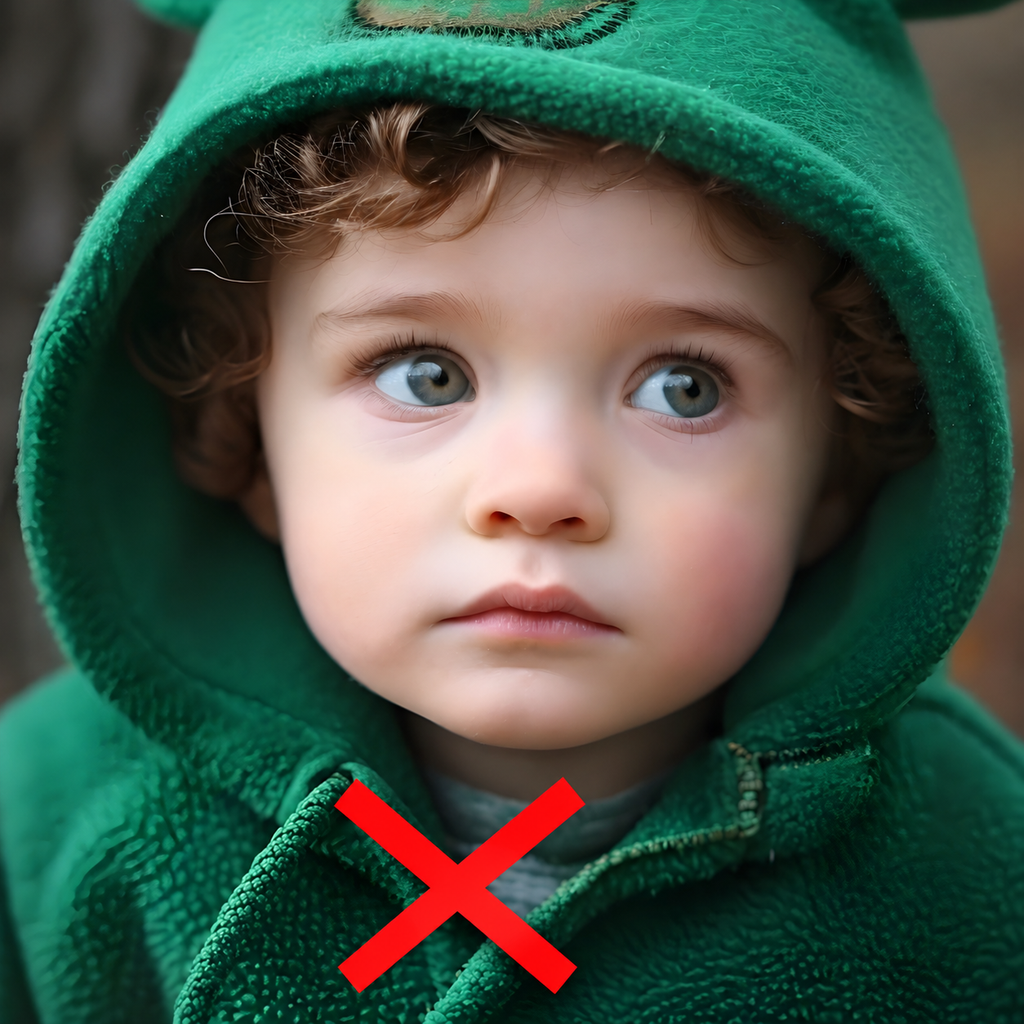
Young children can be seriously injured—or even killed—when drawstrings on their outerwear become caught on nearby objects. Playground slides, handrails, school bus doors, and other moving equipment are among the places where these dangerous entanglements can occur.
Federal Rules on Drawstrings in Children’s Clothing
Anyone who sews clothing for children should understand the Consumer Product Safety Commission’s (CPSC) safety requirements for drawstrings on children’s upper outerwear. More specifically, those garments generally intended to be worn over other clothing.
CPSC defines “upper outerwear” as clothing such as jackets, ski vests, anoraks, and sweatshirts that generally are intended to be worn on the exterior of other garments, including lightweight outerwear that is appropriate for use in warmer climates.
- Underwear, inner clothing layers, pants, shorts, swimwear, dresses and skirts are not considered upper outerwear.
- Belts are not considered drawstrings and are not subject to the requirements.
- Ties are considered drawstrings and are subject to the requirements.
- Underwear and inner layers are excluded.
Children’s upper outerwear sold in the United States should comply with the voluntary safety standard, ASTM F-1816 Standard Consumer Safety Specification for Drawstrings on Children’s Upper Outerwear.
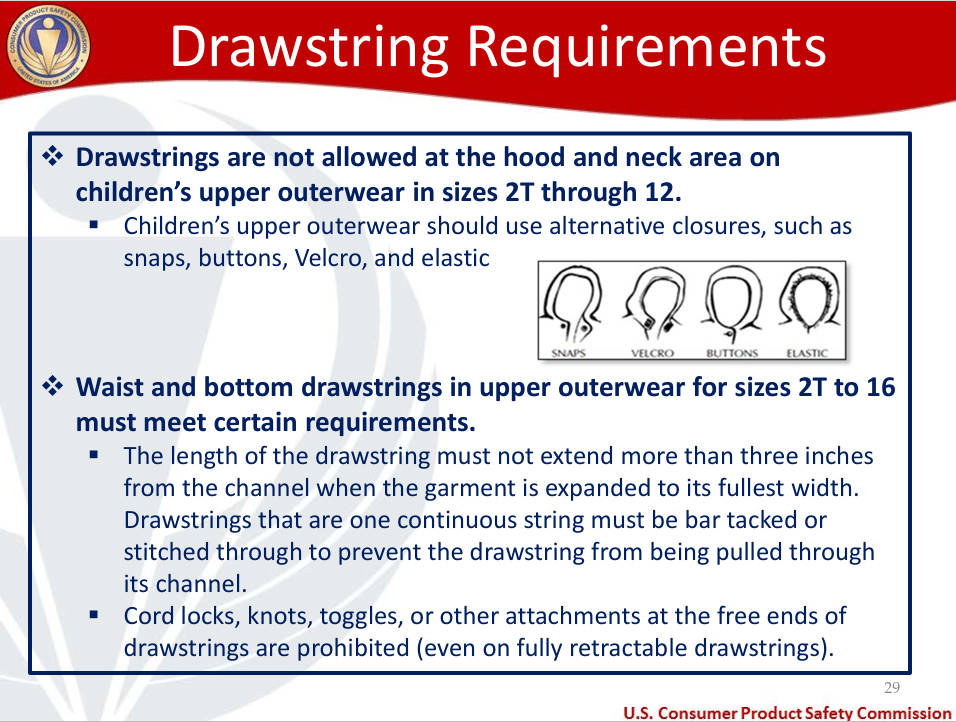
For upper outerwear in sizes 2T through 12, hood and neck drawstrings are completely prohibited. A child’s hoodie, for example, should not have a cord that tightens its hood. Elastic, snaps, buttons, or other suitable closures can provide fit without a dangling string. Note that ties (a closure that can tie, snap or buckle and is attached to the garment through an eyelet, sewn into a seam or run through a casing) are also considered drawstrings and are subject to the regulation.
For outerwear in sizes 2T through 16, drawstrings at the waist or bottom edge are permitted only within specific limits. When the garment is opened to its fullest width, a drawstring must extend no more than three inches outside its channel. Free ends cannot have knots, toggles, cord locks, or other attachments. If one continuous string runs through the channel, it must be secured at the midpoint so it cannot be pulled through to one side. Garments featuring fully retractable drawstrings are exempt. These details matter: even a neatly finished knot or decorative bead can give a loose cord another way to snag.
What about dresses, pants, and shorts?
This is an important distinction for garment sewists. The upper outerwear rule does not classify dresses, skirts, pants, or shorts as upper outerwear. That means its specific size ranges and three-inch measurement should not be presented as a legal rule for every child’s dress or pair of pants. It does not, however, mean a drawstring on those garments is automatically safe.
If you are sewing a child’s dress, consider how it will be worn. A sash attached at the side seams, a short tie at the back, or a decorative bow can give the look of a drawstring without a long cord sliding freely around the garment. Keep ties short enough that they will not trail, loop around objects, or hang where a child might step on them. Check that any decoration is securely attached, especially on clothing for very young children.
For pants and shorts, an elastic waistband often supplies the adjustment a child needs without any exposed cord. If you choose a functional waist drawstring, keep the ends short and avoid knots, beads, toggles, and long loops. Secure the string so one end cannot be pulled much farther out than the other. Check the fit on the child: a cord that looks short on the sewing table may hang differently when the waistband is gathered or the child bends and plays. These are practical precautions, not a claim that the upper outerwear rule legally governs pants.
Give the finished garment a child’s-eye inspection
Before gifting or donating children’s clothing, look beyond the pattern photograph. Fully loosen and tighten every adjustable area. Are there long free ends? Could a loop catch on a slide, door handle, or chair? Could a cord slip through its casing and become much longer on one side? Repeat the inspection after laundering, when ties may shift.
Pay particular attention to garments intended for active play. The CPSC’s playground guidance advises against children wearing clothing with drawstrings, straps, or cords while using playground equipment. If a pattern includes a feature you are unsure about, changing the closure is often easier than trying to make a dangling cord work safely. Read the CPSC playground guidance.
Children’s clothing can be playful and beautifully made without relying on long, loose ties. Knowing where the federal upper outerwear rule applies—and checking drawstrings on other garments with the same care—can help you make thoughtful choices for the children who will wear the garments you create.
~American Sewing Guild