American Sewing Guild (ASG)

Visit our blog Visit the ASG Facebook page Visit ASG on Pinterest Visit ASG's YouTube channel Visit ASG on Instagram
  • Home
  • Join ASG
    • Join Online
    • Chapter Locations
    • Member Benefits
    • Member Brochure
    • Join by Mail
  • Education & Classes
  • Resources
    • Contests & Awards
    • Giving Back
    • Hall of Fame
    • Travel and Tours
    • Measurement Chart
  • Shop
    • ASG Store
    • Chapter Products
    • Video Resources
  • Blog
  • About
    • About Us
    • Donate to ASG
    • ASG Sensitivity Statement
    • FAQ’s
    • Start a Chapter
  • Contact
  • Member Login
    • Login First!
    • Members Only
    • Leadership Only
    • Website FAQ’s
    • Logout
  •  

April 17, 2026

Sewing Room Triangle

The idea of a “work triangle” has long been a cornerstone of efficient kitchen design, helping cooks move seamlessly between the sink, stove, and refrigerator. But what if that same concept could transform your sewing space? Enter the “sewing room triangle”—a practical layout strategy that connects your three most-used areas: the worktable, ironing station, and sewing machine. When thoughtfully arranged, this triangle can streamline your workflow, reduce fatigue, and make your time in the sewing room far more enjoyable.
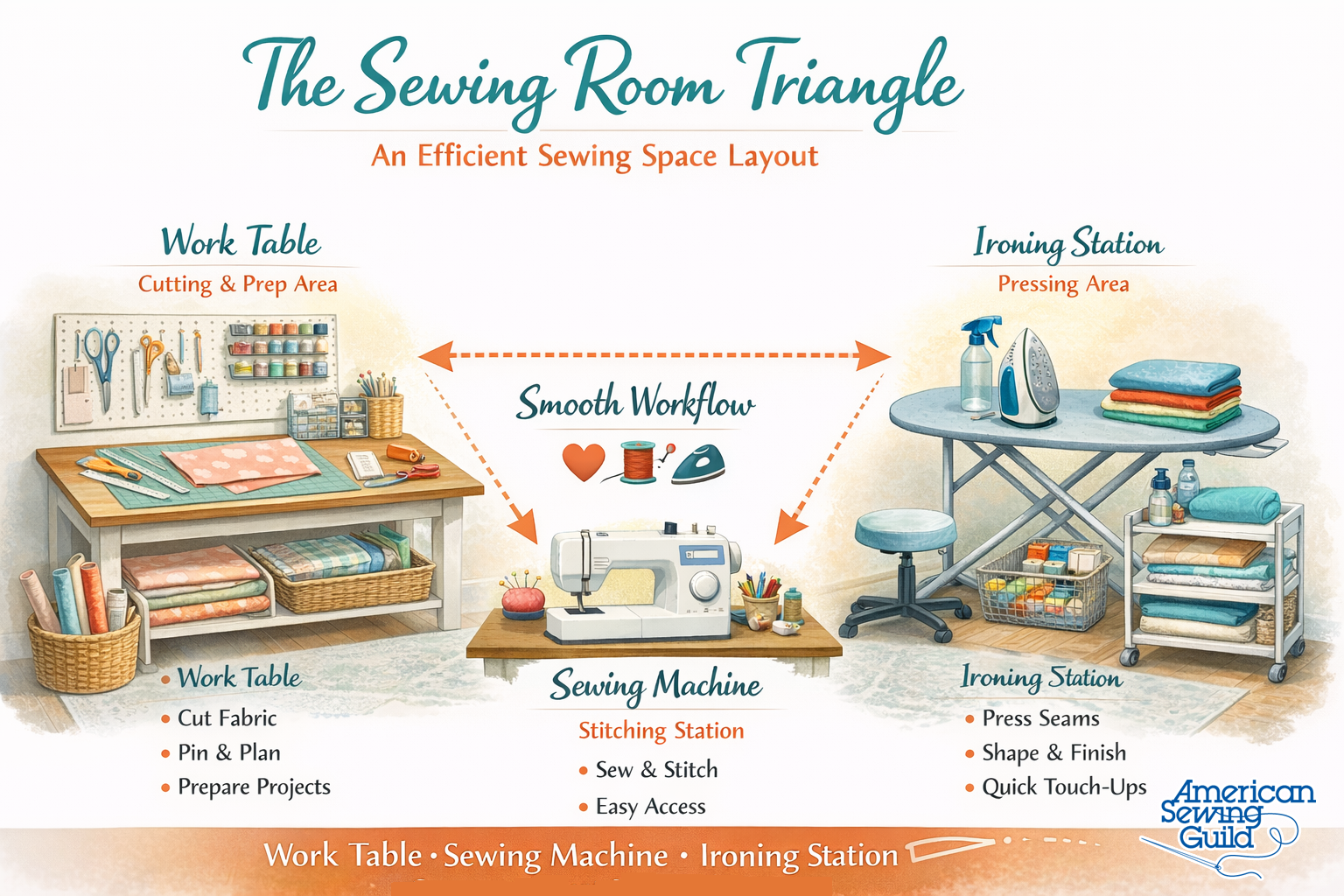
Sewing room triangle layout

At its core, sewing is a process of preparation, construction, and finishing. The work table is where everything begins. This is your cutting and planning zone—the place where fabric is laid out, patterns are pinned, and projects take shape before a single stitch is sewn. Because of its importance, your work table should be spacious, well-lit, and easily accessible. Ideally, it sits at one point of your triangle, with enough clearance around it to move freely, especially when working with larger pieces like quilts or garments.

From the worktable, the next natural step is the sewing machine—the heart of your operation and the center point of your triangle. This is where your project comes to life. Positioning your sewing machine centrally allows you to pivot easily between cutting and pressing without unnecessary steps. It should feel like your command center: comfortable seating, proper lighting, and all your essential tools within arm’s reach. Think seam ripper, scissors, pins, and thread—everything you reach for repeatedly should live here.

The third point of the triangle is the ironing station, which is often underestimated but absolutely essential. Pressing is not just a finishing step—it’s something that happens throughout the sewing process. Seams need to be pressed open, hems need shaping, and fabric often needs smoothing before it ever reaches the needle. Placing your ironing station within a few steps of your sewing machine ensures you won’t skip this critical step out of inconvenience. And let’s be honest—when the iron is too far away, it’s very tempting to say, “That’s good enough,” even when we know better.

The magic of the sewing room triangle lies in proximity and flow. Each point should be close enough to move between them with just a few steps, but not so cramped that you feel boxed in. Imagine a gentle rotation: cut at the table, sew at the machine, press at the ironing station, then back again. This circular workflow minimizes backtracking and keeps your momentum going, which is especially helpful during longer sewing sessions.

Of course, every sewing space is different. Whether you’re working in a dedicated room, a shared space, or even a corner of your home, the triangle can be adapted to fit your needs. In smaller spaces, the triangle may be tighter, with stations doubling up—for example, a pressing mat on your worktable or a fold-down ironing board near your machine. In larger rooms, you have the luxury of spreading out, but the principle remains the same: keep your three key areas connected in a logical, efficient way.
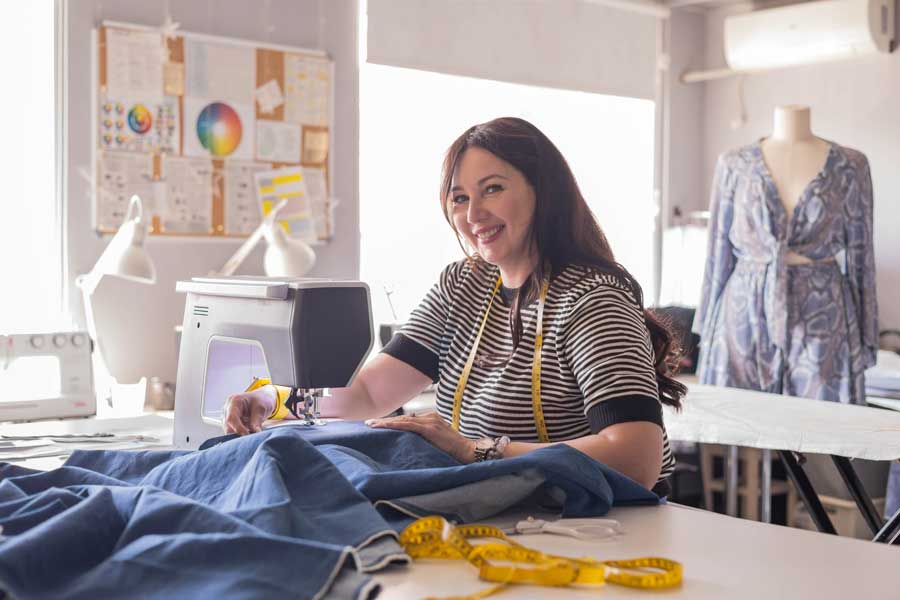
Storage also plays a supporting role in this setup. Keep supplies close to where they’re used. Fabric and patterns belong near the work table, thread and notions near the sewing machine, and pressing tools near the ironing station. This reinforces the triangle and prevents unnecessary wandering around the room searching for what you need.

Another benefit of the sewing room triangle is how it reduces physical strain. Sewing often involves repetitive motions and long periods of sitting or standing. By organizing your space thoughtfully, you can cut down on excessive reaching, bending, or walking. Over time, this makes a noticeable difference in comfort and energy levels, allowing you to sew longer and with greater focus.
Perhaps most importantly, a well-designed sewing room simply feels better to work in. There’s a sense of rhythm and ease when everything is in the right place. Instead of interrupting your creative flow to hunt for tools or navigate around obstacles, you can stay immersed in your project from start to finish.

The sewing room triangle isn’t about perfection—it’s about intention. Even small adjustments, like moving your ironing board closer or rethinking the placement of your machine, can have a big impact. Take a look at your current setup and consider how you move through your space. Are you taking extra steps? Skipping important processes because they’re inconvenient? A few thoughtful changes could transform not just your workspace, but your entire sewing experience.

In the end, sewing should be a joy, not a juggling act. By embracing the sewing room triangle, you create a space that works with you, not against you—one where creativity flows as smoothly as the thread through your machine.


Our thanks to Mary K. from the Northern Virginia ASG chapter for the inspiration for this article!

Tagged With: sewing room organization, sewing room tips

July 22, 2022

Tips and Hacks for Machine Embroidery

Whenever ASG members are asked what they love about their organization, high on the list is always the willingness of fellow members to share ideas and help out with solutions. This is true, especially in neighborhood group meetings held in person or on electronic platforms.

Thought bubbles

The Princeton, NJ Chapter’s “Thread Magicians,” is an online machine embroidery group that is open to all ASG members regardless of their chapter affiliation. ASG members can complete the Group Request here. Non-members can join ASG as part of a chapter or become a member-at-large to participate in this group.

Here are just a few of the tips shared at a recent meeting:

Thread Nets

Marsha in Oregon said she rarely uses the thread nets that are supposed to be used on spools of thread to tame the feeding of thread from the spool to the machine. Instead, she places the nets on rolls of stabilizer to prevent them from unrolling while in storage as well and keeping the plastic use instructions right with the stabilizer. Since the nets are see-through, it is easy to see labels and instructions through the nets without removing them.

Storing Rolls of Stabilizer

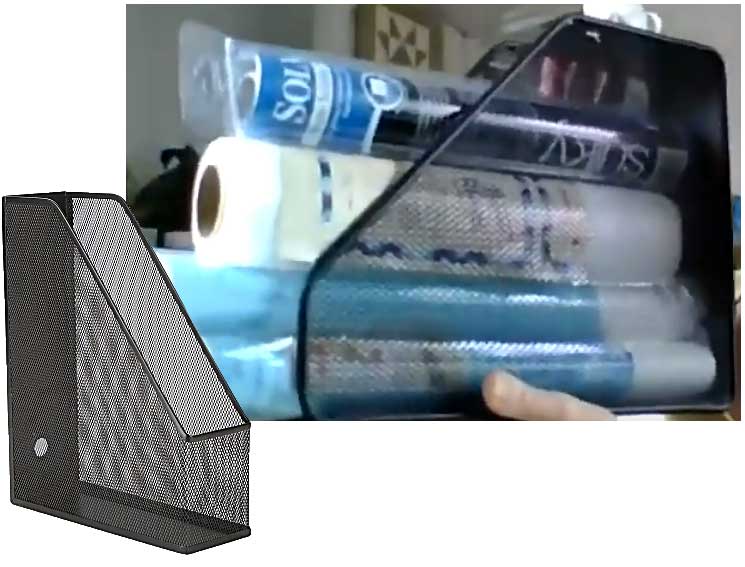
To store rolls of stabilizer, Dale from New Jersey suggested getting some magazine storage containers. The containers all have the same basic shape but can come in cardboard, plastic, metal, or wood. Turn them so they sit on their longest side and tuck the rolls of stabilizer inside. The containers allow the stabilizers to be stacked without fear of them rolling away.

Dale also added that if you have ever had thread unwind and become a massive bird’s nest right on the spool, she suggests turning the spool upside down and allowing the thread to unwind so the nest can be removed. (And yes, this one worked great!)

Thread Organizers

Beverly and Kendra, also from NJ, recycle egg cartons into thread organizers. They number the 12 or 18 compartment cartons and place thread spools into each compartment to keep colors in the order in which they will be used in a design. Even large cones can be inverted and placed in the cartons top down without any trouble. This certainly beats frantically searching for the right color only to find it rolled away during the last thread change. Kendra also suggested using a pet wrap like Coband to wrap around your hoop to prevent slippery fabrics from sliding in the hoop. It doesn’t leave a sticky residue like other tapes. Paper tape from the first aid section of the dollar store also works well for placement of pieces during appliqué or in-the-hoop projects.

thread

Speaking of organizing threads, Constance from Florida suggested cutting pieces of clingy plastic into 1” x 6” or 2” x 6” strips to wrap around thread spools to keep thread from unrolling. The plastic can be purchased from a variety of box stores or recycled from packaging like those that blankets come in. To help keep track of the strips while using the thread, Constance places a line made with a grease pen or permanent marker down the center of the strip, providing a visual reference on an otherwise clear surface. This makes the strip easier to see when not on the spool. For her bobbins, she takes a small box and lines it with double sided tape. When she places bobbins in the box, the tape holds them in place, preventing them from falling out or bouncing around in the box and unwinding and becoming tangled. To be doubly sure the bobbins don’t unwind, she also uses aquarium hose cut to the specific width of her bobbins. She then makes a slit in the hose so that she can slip it around the bobbin holding the thread in place. While many members used ponytail bands to slip around spools and bobbins, the aquarium hose is a smoother, sleeker look and allows bobbins to slip easily into store-bought bobbin holders.

Organizing Appliqué Pieces

Andi in California likes to use page protectors from the stationery store to organize her appliqué pieces. She cuts out the various parts of the appliqué and places them in the page protector along with any notes or instructions. When she is ready to work, the pieces are all together and ready to go. These are especially helpful when she is traveling to a retreat to do the work. Unlike the paper plates she used before, the protectors can be stored in a notebook and don’t slide or allow pieces to escape.

Added Work Surface

While browsing a thrift store, Christine from NJ found a bedside table like the kind that are usually found in hospitals. She said she didn’t know what she would do with it, but she purchased it anyway. Now it is her constant companion while sewing. She can wheel it up to her cutting table and adjust the height to give her extra room for her cutting tools, or even move her sewing machine around the house or outside. It is extra sturdy and can easily handle the weight of her sewing machine as well as the vibration when sewing.

Spraying Adhesives

From Arizona, Sandy suggested cutting the bottom from a gallon milk container and placing the opening over the item she wants to spray with adhesive. She then takes her spray can nozzle and sprays through the top of the container. The sides of the milk container prevent the overspray from traveling around her sewing space and getting everything sticky.

Organizing Machine Feet

To organize her machine feet, Lynda from NJ uses a pill organizer. The compartments are just the right size for most feet and are easily seen through the plastic container. She also says a toe separator used for pedicures makes a great bobbin holder. And if you run out of toppers for embroidery, Glad Press and Seal will work in a pinch. It won’t wash away, but it tears easily.

Storing Embroidery Hoops

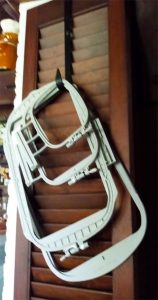
Embroidery hoop storage ideaAfter breaking one of her embroidery hoops by laying it down on a table and then placing something on top of it, Rosemary from NJ bought a wreath hanger from a dollar store. She now slips the hanger over a door near her embroidery machine and actually remembers to place the hoops on the hanger when not embroidering. No more broken hoops!

Go Green

Elaine in Massachusetts shared her “go green” ideas. The Boston Chapter made lint cleaners for attendees at the 2019 conference. Members took a coffee stirrer and half of a chenille stem. The ends of the chenille stem were looped around and inserted into the opening at one end of the stirrer, and voila, a lint brush that gets into those tight spaces around the bobbin case for the embroidery machine or the serger. Elaine also puts her Edge gum boxes to use. She labels them and places her packages of machine needles inside so that she can see at a glance her packages of needles separated by size.

There were also endorsements of a number of products that members find especially helpful.

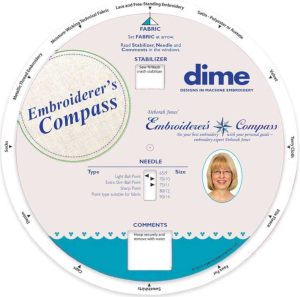
  • Tina from Oregon recommends the Embroiderer’s Compass from dime for matching up the right stabilizer with the right fabric. By simply rotating the disks, this tool gives suggestions for the stabilizer as well as toppers.

Embroiderers Compass on Amazon
Embroiderers Compass on Amazon. We may earn a small commission if you make a purchase.

  • The Perfect Box Bottom is one of Gini’s suggestions from Texas. She says it makes squaring up the bottoms of boxes or purses a breeze.
  • The Hoop Mat by dime was also noted by Beverly as a handy embroidery tool. It prevents the embroidery hoop from sliding away while trying to hoop the fabric. The lines on the mat also help with aligning items.

So, whatever part of the country you hale from, we hope you found some of these tips and hacks useful. Happy stitching!


~Rosemary Fajgier, former ASG Board Chair

This field is for validation purposes and should be left unchanged.
Did you enjoy this article?
Are you an ASG member?

Tagged With: embroidery, machine embroidery, sewing, sewing room tips

Become a Member

Join the only national organization dedicated to Advancing Sewing as an Art and Life Skill.

Join Now button

Blog Article Categories

  • ASG Conference
  • Chapter Stories
  • Embroidery
  • Fitting
  • Learn to Sew
  • National Sewing Month
  • Products, Books, & Patterns
  • Projects
  • Quilting
  • Sewing
  • Sewing Techniques
  • Sewing Tips
  • Sewing Tours
  • Videos
  • Disclaimer
  • Privacy Policy

American Sewing Guild
National Headquarters
9660 Hillcroft, Suite 230
Houston TX 77096
713-729-3000 | 713-721-9230 Fax
www.ASG.org

ASG wordcloud - education, conference, discounts, videos, special offers, tours and more

Copyright © 1998–2026 · American Sewing Guild · All Rights Reserved