Our short video on using the Bias Tape Tool will show you how to make your own bias tape, but do you know how to join your fabric to create the bias strips? This video will show you how.
~© ASG; Sheryl Belson, Plano Chapter
Our short video on using the Bias Tape Tool will show you how to make your own bias tape, but do you know how to join your fabric to create the bias strips? This video will show you how.
~© ASG; Sheryl Belson, Plano Chapter
There are basically two types of tailoring: traditional work with tedious hand stitching or fusible tailoring where you let technology do the “stitching” for you. While the former is worthy of the effort, most first-time tailoring adventures are successfully done with fusible techniques.
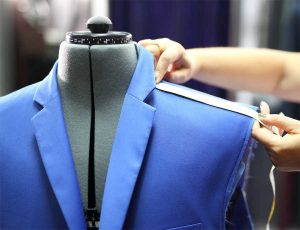 Wool or a wool blend is the best choice for a tailored garment, as it’s easily shaped with steam and good pressing techniques. Preshrink your wool selection prior to sewing—easily done by asking your dry cleaner to steam press it for you, though some wools are washable, so check the label first.
~Linda Griepentrog
Linda is the owner of G Wiz Creative Services and she does writing, editing and designing for companies in the sewing, crafting and quilting industries. In addition, she escorts fabric shopping tours to Hong Kong. She lives at the Oregon Coast with her husband Keith, and two dogs, Yohnuh and Abby. Contact her at gwizdesigns@aol.com.
Perhaps you use your serger only for making neatly finished seams—but there’s so many other things you can do with it. One of my favorites is a rolled hem.
Whether you’re creating beautiful edges on napkins or silk scarves, or delicate hems on lingerie, the rolled hem is perfect to hide any “pokies” of thread along the edge. It’s also ideal for quickly finishing ruffle edges.
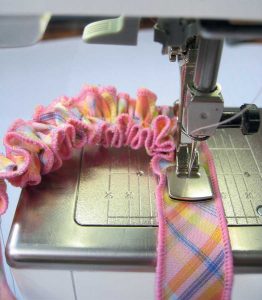
Before you begin the rolled hemming process, read your instruction manual for setting adjustments. Some brands of sergers utilize a different needle plate, others a separate foot or attachment, but common to all is altering settings so that the fabric edge rolls under. This is usually accomplished by making adjustments to the tension settings and stitch width, and using only one needle.
Narrow rolled hems can be stitched with regular serger thread or a novelty thread, like Woolly Nylon or a texturized polyester that fills in the stitched area. These threads will produce more of a satin stitch look to the edge, covering the entire fabric edge. Using rayon thread in the upper looper will produce an edge with a sheen, while texturized polyester thread creates a matte finished edge.
If your serger has a standard setting for a rolled hem, follow the instructions for its use. If you need to manually adjust, begin by using a narrow stitch finger for a perfect roll. Tighten the lower looper tension so that the fabric edge rolls under and is encased by the upper looper thread. You may need to adjust the needle tension to perfect the stitch. Shorten the stitch length to produce the look you want. It’s all a matter of testing on the fabric you want to hem, as each fabric reacts differently. Softer fabrics roll easier than stiffer fabrics which may not roll at all.
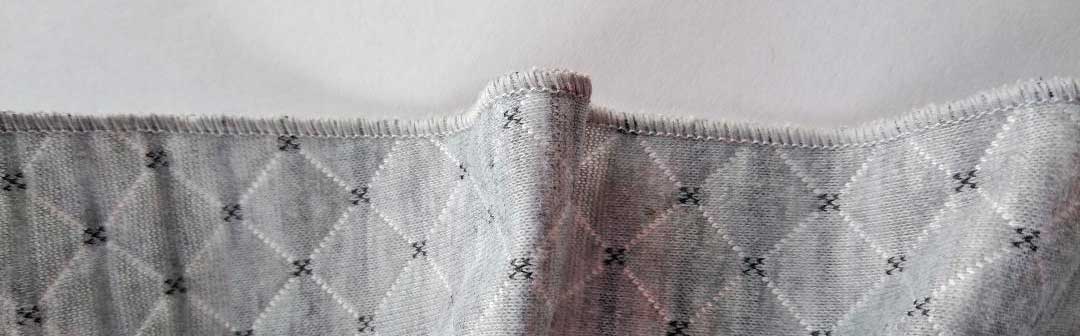
For variation, try using a variegated thread, but note that you might produce a striped edge depending on the thread brand, as some threads are dyed in regular intervals, while others are dyed randomly.
In addition to creating a lovely edge finish, a narrow rolled hem can also be used to stitch a seam in delicate fabrics like lingerie tricot or sheers. Only the width of the stitch shows, creating an almost invisible seamline. To use as a seam, leave the stitch length slightly longer than for edge finishes to keep the seam soft and subtle.
~Linda Griepentrog
Linda is the owner of G Wiz Creative Services and she does writing, editing and designing for companies in the sewing, crafting and quilting industries. In addition, she escorts fabric shopping tours to Hong Kong. She lives at the Oregon Coast with her husband Keith, and two dogs, Yohnuh and Abby. Contact her at gwizdesigns@aol.com.
 Napped fabrics are normally cut so that the nap runs down the garment, from the top down toward the lower hem. This feels softer, and the fabric tends to pill less and wear better. However, when the nap runs up, the color is richer.
Short-nap fabrics, such as corduroy and velour, can be cut with the nap running up to achieve a richer, deeper color and a more interesting texture.
Outerwear fabrics with heavy and longer surface fibers, such as fleece and camel’s hair, should be cut with the nap running down, so the pile is smooth and the garment repels moisture better.
~ Thank you to www.sewing.org for this tip (reprinted with permission)
Bias tape is most often used to finish the edges of garments, especially along curved edges like armholes and necklines. But it can also be used as a decorative element on garments (think pockets and hems for example) or on other projects, like handbags, quilts, table runners and Christmas stockings. You can purchase packaged bias tape, but it’s very easy to make your own with a Bias Tape Maker tool. This short video will show you how easy is it to DIY your own bias tape.
~© ASG: Thank you to Sheryl Belson, ASG Plano Chapter