American Sewing Guild (ASG)

Visit our blog Visit the ASG Facebook page Visit ASG on Pinterest Visit ASG's YouTube channel Visit ASG on Instagram
  • Home
  • Join ASG
    • Join Online
    • Chapter Locations
    • Member Benefits
    • Member Brochure
    • Join by Mail
  • Education & Classes
  • Resources
    • Contests & Awards
    • Giving Back
    • Hall of Fame
    • Travel and Tours
    • Measurement Chart
  • Shop
    • ASG Store
    • Chapter Products
    • Video Resources
  • Blog
  • About
    • About Us
    • Donate to ASG
    • ASG Sensitivity Statement
    • FAQ’s
    • Start a Chapter
  • Contact
  • Member Login
    • Login First!
    • Members Only
    • Leadership Only
    • Website FAQ’s
    • Logout
  •  

November 8, 2019

Button and Buttonhole Positioning

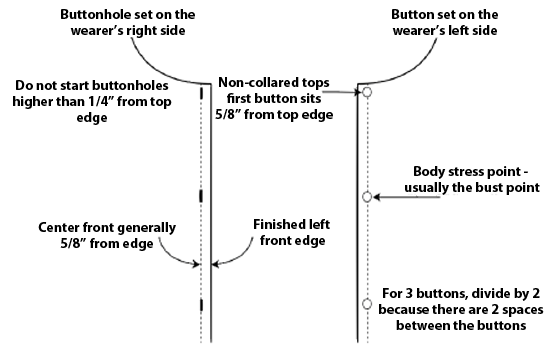
Button & Buttonhole Placement on the ASG blogButton and buttonhole placements can sometimes be confusing. If the button and buttonhole are placed incorrectly, the garment may be too tight, too loose, or create gaping. The number of buttons on the garment is suggested on your pattern envelope, but it’s up to your personal preference or need. A good guide to start placing your buttons vertically is to keep in mind your body’s pressure points. Pressure points are where your body may put strain on the garment and may be your bust, belly, or even the hip if you are making a button front dress or skirt.

Button Placement

Once you have identified your pressure point(s), mark these on your muslin or sloper (block) pattern for future reference.

  • Decide how many buttons to use.
  • Lay your pattern or muslin flat, mark the center front and your pressure points.
  • Place your highest and lowest buttons on the muslin.
  • Measure the distance between your top and bottom buttons.
  • Divide this distance between the number of buttons you will use. If you use 5 buttons, divide by 4. You will always divide by one less button, because that is the number of actual spaces between your buttons.
  • Determine if the button placement falls on your pressure point(s). If not, you may want to adjust the position slightly to hit that sweet spot.
Buttonhole Position

Now that you have the button position, you need to determine if you want vertical or horizontal buttonholes. Horizontal buttonholes will need a facing deep enough to fit the entire length of the buttonhole. I have seen some patterns where the facing is too narrow for horizontal buttonholes. Vertical buttonholes allow for button play. This means if the button is not set exactly in the measured spot, there is room for the button to move up and down within the hole.

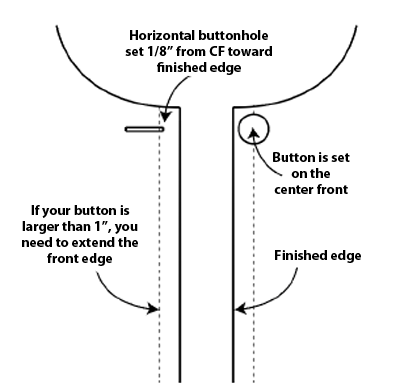
The distance between center front and the finished edge of your garment is generally 5/8”. This is okay if your button is 7/8” or smaller. If the button is larger, you will need to extend the distance from CF to the finished edge of your garment.

Buttonhole Size
To figure out what size buttonhole to use, some machines have a button hole foot that the button sits on the back carriage and the machine will make a buttonhole to that size. Or you have a machine that is computerized and you can adjust for your button size. The general rule of thumb is, the buttonhole needs to be 1/8” bigger than the button, for ease of going through the hole.

  • 1/2” button uses a 5/8” buttonhole
  • 5/8” button uses a 3/4” buttonhole
  • 3/4” button uses a 7/8” buttonhole

Good Buttonhole Practices

When making a vertical buttonhole, the button and buttonhole will be placed exactly at center front. In the case of horizontal buttonholes, the button is set at center front, but the hole is started 1/8” away from center, toward the finished edge. If your garment needs a button at the top edge, I start at 5/8” down for the button placement, but you can decide how far down, depending on the width of your button. But never start a buttonhole higher than ¼” below the neck edge.

  • Always make a test buttonhole with the same thickness as your garment, Top fabric, bottom fabric and interfacing. Make sure your button will pass through the hole easily.
  • Buttons are set on the left front and buttonholes on the right front for women’s garments

Something that I do for jackets, especially for horizontal buttonholes, is to set all the buttonholes along the edge of your fabric BEFORE cutting out the front body. This allows for checking the placement without chancing ruining the garment and works best for bound button holes because the inside opening is usually hand finished.


~© Annalisa T, Alameda County Chapter
Tagged With: buttonholes, buttons, sewing

November 1, 2019

Guide for Seam Finishes

You have all of your supplies ready, you’ve adjusted your pattern, cut your fabric and you’re ready to start sewing. Before you sit down at the machine, have you thought about the best seam finish to use for your fabric? This post will help you to choose the best method to assure your seams are perfect.

Fabrics & Best Seam Finishes

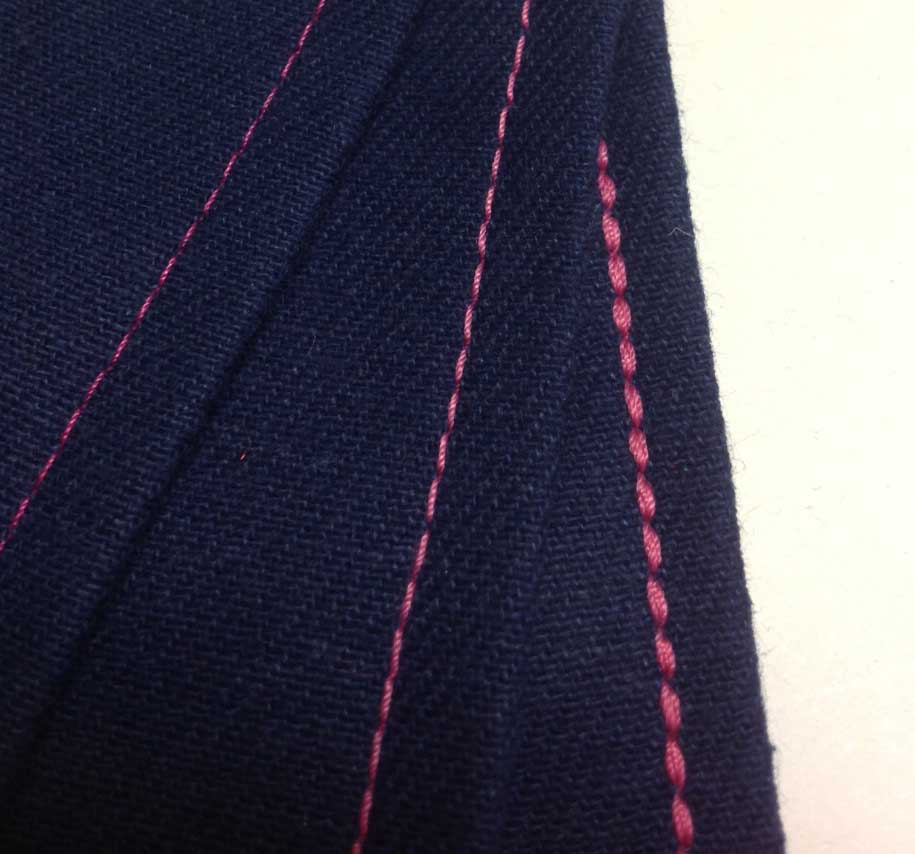
  • Learn what searm finishes to use on different fabricsBatik: Flat fell seam or sew with a plain seam and serge together
  • Batting: Butt the raw edges together and hand overcast with basting thread to get the width you need.
  • Beaded Fabric: Finish with a product like Great Seams as in Hong Kong finish. Eliminate facings. Finish the neck and armholes with bias silk charmeuse or line your garment, making the attachment at the neck and shoulders.
  • Boiled Wool: Sew seams and clip curves. Press seams open and top-stitch on each side from the right side using a wide double needle or top-stitch each side separately from 1/8” to 1/4” allowance from the seam. Trim to your top-stitching.
  • Brocade: Press seams open and overlock separately, even if lined. Use a Hong Kong finish with lightweight silk or bind separately with double fold bias.
  • Burnout: Finish with a narrow French seam.
  • Charmeuse: Use flat fell or French seam on serger.
  • Chiffon: Use a narrow French seam. On long vertical seams, sew with tiny zig-zag stitches to prevent drawing up.
  • Corduroy: Serge seams separately or flat fell the seams.
  • Crinkle: Sew with a tiny zig-zag.
  • Damask: Sew flat fell seams.
  • Denim: Sew a straight seam. Serge one seam allowance and trim the other without turning under. Overlap the serger seam allowance onto trimmed seam allowance and topstitch. This forms a fake flat fell seam that is less bulky.
  • Dupioni: Serged or traditional flat fell; serge and press open.
  • Faux Fur: None
  • Faux Leather: Use a fake flat fell seam or finger press open and top stitch from the right side, straddling the seam. Trim close to stitching.
  • Faux Suede: Lightweight ultra suede seams can be simply pressed open. Other faux suede’s can be top-stitched with a double needle or treated with a fake flat fell seam.
  • Flannel: Straight stitch or flat fell seam
  • Fleece: Sew with a straight seam and finger press open. Top-stitch or serge.


  • Gabardine: Press seam open and serge each side separately with a woolly nylon in lower looper; flat fell; or Hong Kong bound.
  • Georgeette: French seam.
  • Jersey: For lightweight knits, sew the seam, press to one side and top-stitch 1/4’ from seam. Trim extra fabric away. For invisible seams on wool jersey, zig-zag and press open.
  • Mudcloth: Flat fell or bind with double bias.
  • Rayon: Flat Fell or press open and serge.
  • Slinky: Four thread serge with Woolly Nylon in lower looper. Use differential feed if needed.
  • Sweater Knits: Stabilize horizontal seams and neckline using 1/4” clean elastic. Sew seams with small zig-zag then four thread serge. You can also sew with a lightening stitch and bind with Great Seams.
  • Tencel: Flat fell or press open and serge separately.
  • Velvet: Press open, pink or or serge separately.

© Sunny Kent, ASG Inland Empire Chapter

Tagged With: fabric, seams, sewing

October 4, 2019

Hemming Jeans – the Denim Blues

Hemming JeansPerhaps you searched long and hard for the perfect fitting jeans, but alas, they’re too long! Or maybe you painstakingly created a custom pair and it’s time to hem them. Either way, you’re in the thick of it—literally!

The hem area of jeans can be up to eight layers thick, depending on how the side and inseams are constructed. Stitching through all of that thickness while maintaining straight, even stitches and not breaking the needle can be a challenge for any sewer, but here are some helpful hints to make the process easier.

Before you sew

Before you determine the length of your jeans, be sure to wash and dry them at least twice to allow the fabric to shrink. Nothing’s worse than meticulously hemming them and after the first wash, they’re ankle skimmers.

Try on the jeans with the shoes you plan to wear with them and pin-mark the desired finished length on both legs. Both legs aren’t always the exact same length.

Assemble the arsenal

Denim Needles

Having the proper tools to sew multiple denim thicknesses is a must. First, select a denim or jeans needle with a special tip and blade to cut through the fibers without deflecting (because of the tight weave) or breaking. Denim needles are made especially for sewing extra thick fabrics, and they’re available in sizes 70/10 to 110/18—the heavier the denim, the larger the needle size needed.

Topstitching

In addition, if you’re doing decorative topstitching to mimic the infamous Levi gold version, acquire a topstitching needle with a large eye and groove to accommodate jeans thread without shredding.

Denim ThreadDenim Thread

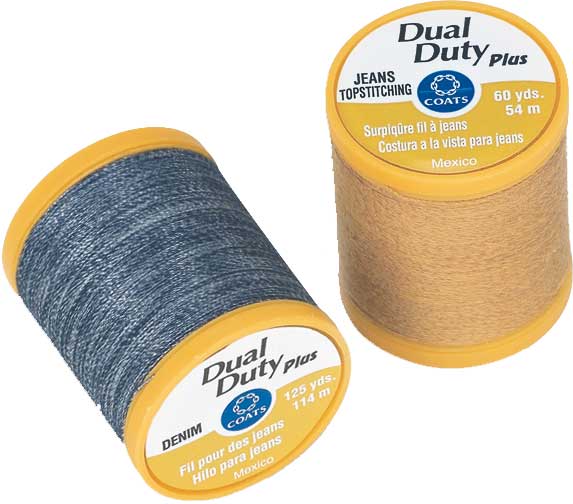
Choose either an all-purpose or denim blue thread for stitching if you want a matching hem, or a heavier jeans thread if you prefer contrast seaming detail. Denim thread is a twist of multiple blue colors to mimic the looks of our favorite indigo fabric.

Hemming

  • Press up the hem at the desired length and trim the hem allowance, leaving about 1”. Press under ¼” along the upper hem edge, then ¾” forming a double hem. Pin in place.
  • If you need a bit of stability on lightweight denim, slip a narrow strip of fusible web into the hem area and press before stitching to firm up the edge.
  • Straight stitch along the upper folded edge using matching or contrasting thread. For more prominent stitching, use a straight stretch stitch.
  • On very heavy denim, serge the upper hem edge instead of folding it under to finish, and that will save one layer of thickness.

Height busters

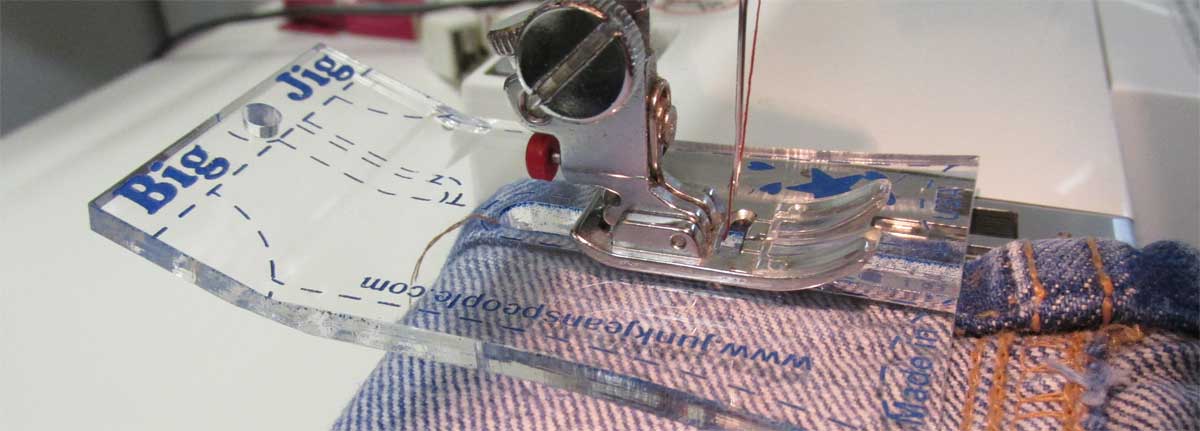
The absolute hardest part of hemming jeans is going over those leg seams, but there are tools to help. Look for a Jean-a-ma-jig, Hump Jumper or Big Jig to help even out the raised area.

Hemming Jeans - Big Jig

These tools are slipped under the presser foot on the ascent to the leg seam thickness to help keep the presser foot horizontal over the ridge and again on the other side to keep it from sliding off the raised area and making uneven stitches on the downward journey. And, they work on all machines.

For the neatest appearance, bring thread ends to the wrong side and tie them off instead of backstitching.


~ By Linda Turner Griepentrog
You might know my name from my years as editor of Sew News, from the many magazine articles I’ve written, or perhaps you’ve been on one of the ASG Sew Much Fun Hong Kong tours with me. But soon you’ll be seeing my name a bit more often as I’m writing for the American Sewing Guild blog!


Tagged With: garment sewing, jeans, sewing, sewing tips

January 2, 2018

Learn to Sew: What Does Right Sides Together Mean?

What does it mean when a sewing pattern says to place the “right sides together”? Watch this 2 minute video to learn the meaning.

January 2, 2018

Learn to Sew: What is Seam Allowance?

What is a seam allowance? Watch this 2 minute video to find out.

  • « Previous Page
  • 1
  • …
  • 10
  • 11
  • 12
  • 13
  • 14
  • 15
  • Next Page »

Become a Member

Join the only national organization dedicated to Advancing Sewing as an Art and Life Skill.

Join Now button

Blog Article Categories

  • ASG Conference
  • Chapter Stories
  • Embroidery
  • Fitting
  • Learn to Sew
  • National Sewing Month
  • Products, Books, & Patterns
  • Projects
  • Quilting
  • Sewing
  • Sewing Techniques
  • Sewing Tips
  • Sewing Tours
  • Videos
  • Disclaimer
  • Privacy Policy

American Sewing Guild
National Headquarters
9660 Hillcroft, Suite 230
Houston TX 77096
713-729-3000 | 713-721-9230 Fax
www.ASG.org

ASG wordcloud - education, conference, discounts, videos, special offers, tours and more

Copyright © 1998–2026 · American Sewing Guild · All Rights Reserved