American Sewing Guild (ASG)

Visit our blog Visit the ASG Facebook page Visit ASG on Pinterest Visit ASG's YouTube channel Visit ASG on Instagram
  • Home
  • Join ASG
    • Join Online
    • Chapter Locations
    • Member Benefits
    • Member Brochure
    • Join by Mail
  • Education & Classes
  • Resources
    • Contests & Awards
    • Giving Back
    • Hall of Fame
    • Travel and Tours
    • Measurement Chart
  • Shop
    • ASG Store
    • Chapter Products
    • Video Resources
  • Blog
  • About
    • About Us
    • Donate to ASG
    • ASG Sensitivity Statement
    • FAQ’s
    • Start a Chapter
  • Contact
  • Member Login
    • Login First!
    • Members Only
    • Leadership Only
    • Website FAQ’s
    • Logout
  •  

May 29, 2020

Stretching Yourself: Using Elastic Thread

We’re not talking about aerobics, but using elastic thread! Building stretch into a garment is easy with this thin, stretchy strand and a little ingenuity. Sections of your project, like yokes, sleeves, cuffs, waistlines and bodices are all likely candidates for shirring.

Shirring refers to sewing multiple parallel rows of stitching using elastic thread in the bobbin.

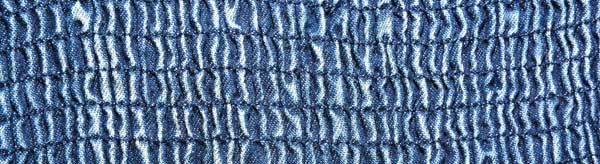
Shirring on distressed denim
Shirring using elastic thread on distressed denim

Shirring Tips

Shirring works best with lightweight fabrics, like voile, linen, etc., but you can also do it on lightweight denims and silks.

Look for elastic thread at the notions counter of your favorite store. It’s available in black and white. Some knitting stores may offer elastic thread in other colors. If you have elastic thread in your stash, double check it before use, as elastic can deteriorate over time.

Wind the bobbin by hand, not using the machine’s standard mechanism. Don’t stretch the thread while winding, but also don’t let it be too loose or you won’t get good shirring results. Fill the bobbin as far as possible, but be sure the thread doesn’t extend beyond the bobbin edge. If you’re doing a large project, wind multiple bobbins at once.

Insert the bobbin into the bobbin case and thread it like normal. Place regular thread in the top of the machine. Set the stitch length from 3 to 5mm for test stitching.

Test-stitch on the right side of the fabric and adjust the stitch length and tension as needed to get a look you like.

Draw lines on the right side of your project so that the stitched rows begin and end inside the seam allowance of the garment. You can draw multiple lines, or use a quilting guide for spacing, or the width of the presser foot.

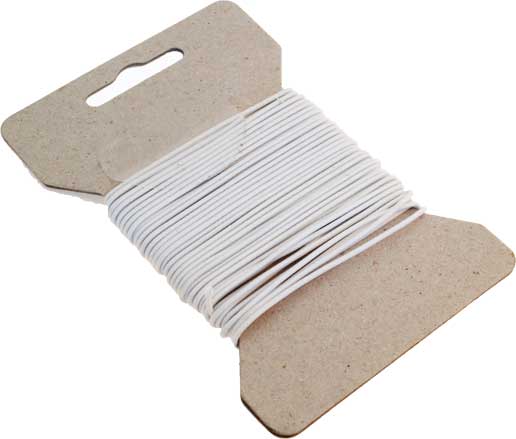
Elastic thread

Pull out about 2” of elastic and top thread to begin the stitched row. Sew along the first marked line, sewing slower than you normally do. At the end of the row, pull out 2” of elastic thread and top thread as well. Do not use the automatic thread cutter with elastic thread and do not backstitch. Tie off the threads on both ends of the stitching line. Repeat for all the marked lines, keeping the fabric flat as you stitch subsequent rows.

If you run out of bobbin thread while sewing, simply tie off the thread ends and start sewing with a new bobbin where you left off. Anchor the new threads in the same manner by tying off securely.

When all rows are stitched, steam the elasticized area to create the final shirring effect. Set the iron for steam and simply hover it over the stitched area right side to set the stitching and elastic in place. The steam causes the elastic thread to shrink up the shirring a bit.

Sew the seam crossing the stitched rows and stitch again 1/8” from the first line to securely anchor the ends.

Elastic thread can be machine washed and dried at temperatures under 200°. Do not put the iron directly on the elastic, as it can be damaged by higher heat.


~Linda Griepentrog
Linda is the owner of G Wiz Creative Services and she does writing, editing and designing for companies in the sewing, crafting and quilting industries. In addition, she escorts fabric shopping tours to Hong Kong. She lives at the Oregon Coast with her husband Keith, and two dogs, Yohnuh and Abby. Contact her at gwizdesigns@aol.com.
This field is for validation purposes and should be left unchanged.
Did you enjoy this article?
Are you an ASG member?


Tagged With: elastic, elastic thread, sewing, shirring

April 17, 2020

Shelter in Place, Save Money and Sew!

You are living your best quarantine life, sewing up a storm and suddenly realize you are out of… or can’t find… or never had… something you need to finish your project. No matter what it is, you have no interest in going out into COVID world to pick up a spool of thread, a rotary cutter blade or a new pair of thread snips to replace the ones you must have dropped into the trash because they are nowhere to be found.

Now what?

Did you realize just how many of these things you can order online with a member discount?

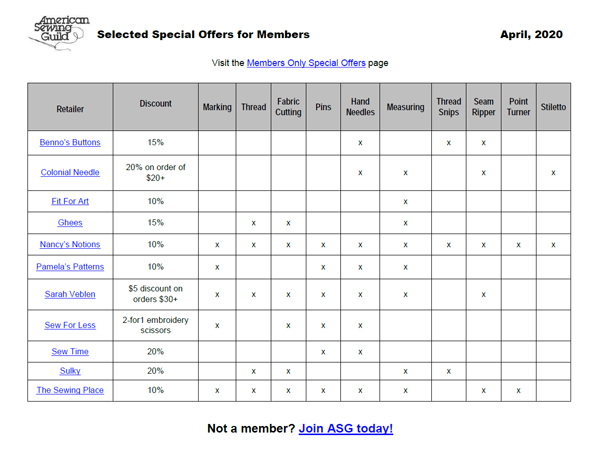
We combed through the entire list of Special Offers just for members on ASG.org and created this table with the companies who carry some frequently needed sewing notions for you to have at your fingertips. Be sure you visit the members only Special Offers page to get the discount code to use when you place your order. Now it’s your turn! Go replenish your supply from the safety of your own home and enjoy great discounts while you do.

Click to open full size pdf file
Click the image to open full size pdf file

~Sheryl Belson

This field is for validation purposes and should be left unchanged.
Did you enjoy this article?
Are you an ASG member?

Tagged With: discounts, sewing supplies, shopping

April 3, 2020

Can Silks be Washed?

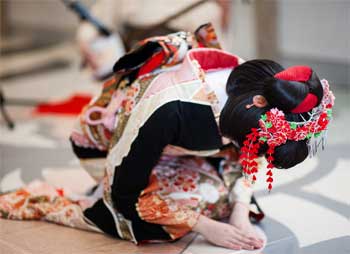
One of my college classmates was a very recent immigrant from Korea and she once asked me to help her wash her “dance kimono.” Naturally I was eager as it is “common” knowledge that silks should never be washed. What I learned continues to influence my sewing today.

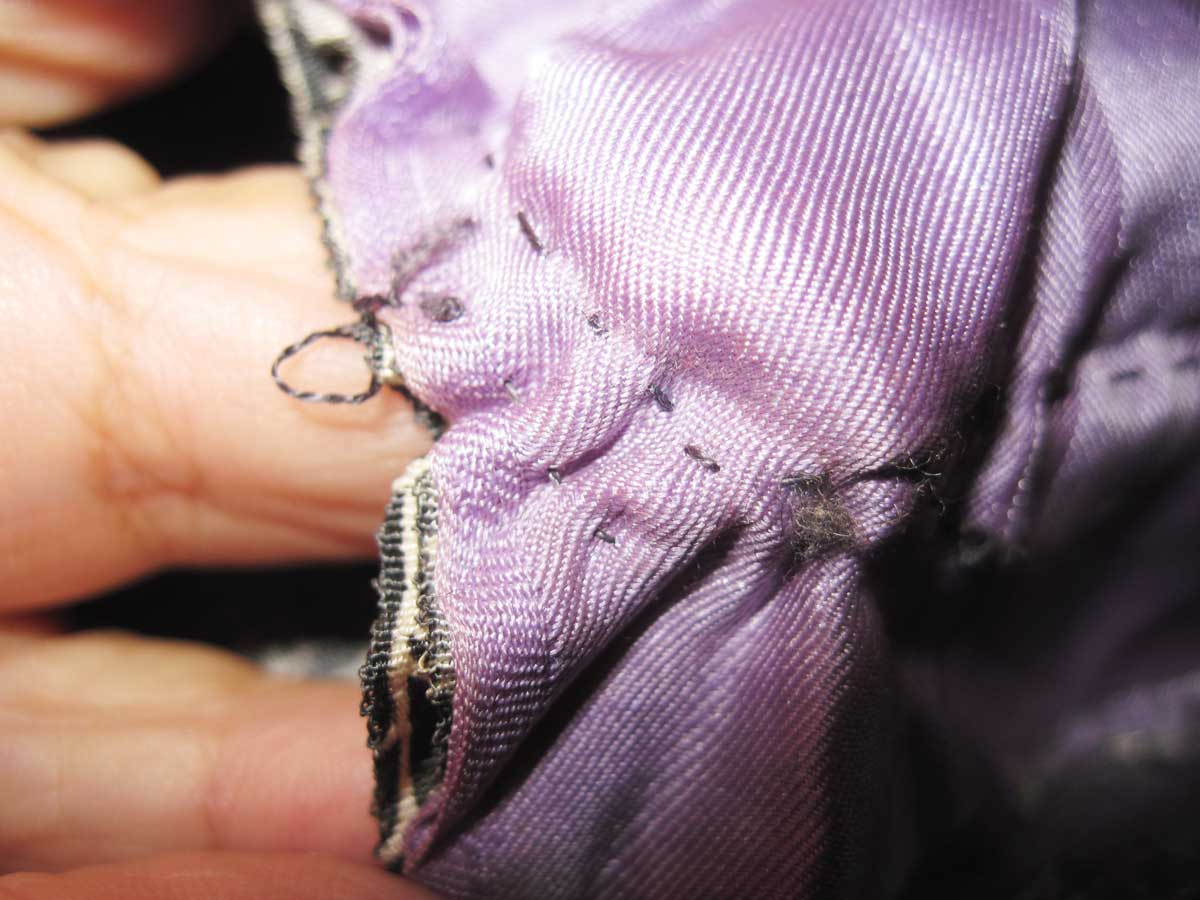
Her kimono was pieced of over 50 strips (up to 3″ in width) of silks, plus bindings (such as strips edging the collar) in different colors. Because the dyes were not colorfast, she had to take the entire kimono apart and wash every color separately, then press and sew back together with long stitches.

Lesson 1

Wash all fabrics separately until you determine whether the dyes are colorfast (like sweatshirts!).

Lesson 2

Don’t complain if a Western-style garment needs to be pressed after washing ─ doing laundry really could be worse.

The collar area was doubled fabric; it did not have a separate interfacing material and the excess was not secured so kimono collar would wrinkle and bunch up if washed.

Lesson 3

Baste or quilt any intact original kimono collar to wash. If making western style garments, make sure interfacings are secured. If deconstructing kimono to re-purpose fabrics, the collar probably has double the visible fabric.

Obi (belt) is generally the most elaborate part of the costume. It is also very stiff, the purpose is partly like a corset. For a light-weight silk, the stiffness is provided by covering a very dense canvas-like fabric, which is always blocked to retain the original size – unless you don’t plan to reassemble the obi.

Stitch lengths

Lesson 4

Unseen construction materials affect whether silk (or any) garments can be washed, so pre-shrink.

Some silks reveal textures that may not be apparent until wet. These fabrics may have quite subtle matte/shiny differences due to threads that are spun differently and thus shrink at different rates. All of these silks are intended to be blocked when washed.

Lesson 5

If you like texture, enjoy, even if you now have less fabric! Better to adjust plans than to finish and then shrink.

The following are things I’ve learned from deconstructing and re-purposing obi and kimono.

Both obi and kimono fabrics are woven in widths of 10-14 inches, and the garments utilize that to the fullest. The rounded corners of sleeves are left square and not trimmed, with the excess fabrics bunched up in the curved area.

Curved corner on a sleeve

If smaller sizes of kimono are made, seams are made extra wide but not cut off. If extra width is needed an entire extra panel of fabric may be sewn into the side and is not cut or could be half the width, with very wide seam allowances. Extra length will probably be turned up on the inside to replace some of the lining fabric. All of this is to take advantage of taking apart garments to wash, as when re-assembled fabrics can be turned to even out wear or to change the fit/size. No worries if you gain or lose a little weight; alter each time you wash!

Seam allowances

Most of the rolls of fabric were made specifically for either obi or kimono, with pre-planned cutting marks. Bolts of fabric are a new concept. This means that the fancy portions of obi could be in the only area(s) that show, while plain fabric is woven for the rest. Do not assume the entire length is what is seen on the outside.

Some fabrics such as brocades and jacquards may fall apart or unravel if cut. This is not a problem for kimono or obi as the fabrics are nearly always left with selvages intact, with the exception of obviously pieced dance and fancy garments.

INSPIRED? Antique Pattern Library has antique kimono fabric designs and stencils in the “J” and “K” sections.

Lesson 6

Test a small cut before re-purposing kimono or obi; particularly be careful if threads are carried on the back. Also examine carefully to locate any possible embroidery and avoid cutting through that area. Embroidery threads may not be colorfast so know it could possibly bleed when washed, particularly true on ornate garments.

Examine carefully if there are any metallics. If painted/stenciled it could be metallic leaf that is not washable as it will flake off. If the metallic is woven in, test first but the threads are probably washable if of the same weight as the other threads. If the metallic threads are heavier or if embroidered, it is probably NOT washable due to the construction method of heavier metallic threads.

There are several ways to use for garments: (1) kimono are wrapped and tied, so many people can wear as open jackets/vests without altering; (2) side inserts can be added to keep the front area intact: use the bottom of long kimono, sleeves, linings, parts from a second kimono, other fabrics; (3) I’ve taken kimono apart completely and re-sewed into large enough blocks to cut Western-style blouses and jackets.


~Hope Wright, ASG Member, Springfield Lincolnland Chapter

This field is for validation purposes and should be left unchanged.
Did you enjoy this article?
Are you an ASG member?

Tagged With: kimono, sewing tip, silk, texture

March 17, 2020

Sewing with Vinyl

This quick video has 3 tips for sewing with vinyl.


This field is for validation purposes and should be left unchanged.
Did you enjoy this article?
Are you an ASG member?

Tagged With: sewing, sewing tip, vinyl

February 28, 2020

Ending it All (serger stitching, that is)

We all love sergers for stitching and finishing our seams all in one operation. Those loopers and needles just seem to zing along the edges, but what happens at the ends is something to note. You can’t backstitch with a serger like a conventional machine. Do you just cut off the threads and hope for the best, or do you plan a neat finish for the threads that would make your home ec teacher proud?

There are several options for finishing the ends of serger seams, depending on the location and actual type of seam you’re using.

The easiest way to anchor serger threads is to cross them with another line of stitching. For example, if you’ve serged seams in a skirt, you’ll be crossing them with a waistband or facing and a hem finish. The perpendicular stitching is enough to hold the serger threads in place and keep them from raveling.

Another way to finish serger seams is to apply seam sealant to the threads, let it dry, then trim the threads close to the fabric. This is a great option for rolled hems or places where you don’t want other visible fastening of the threads. The down side of this method is that seam sealant can make the threads a bit stiff (depending on the product brand), it can be a bit messy to apply so best to do so with a pin to avoid getting it on the adjacent fabric, and you have to wait for it to dry before moving on in the construction process. (You can speed up the drying process by sandwiching the area between paper towels and pressing.)

How about knotting the threads? Good idea, and it can be done two ways. First, simply tie the serger chain in a loose overhand knot, use a pin to push it down to the fabric edge and tighten the knot to secure. Cut off the thread ends close to the knot. Depending on the thread and location, this can make a highly visible fastening. Another knotting option is to separate the threads from the serger chain so that you have them paired—one looper and one needle together, and tie a small knot with the two close to the fabric, then clip the ends. This makes a more discreet knot than the overhand version, and is great for decorative threads or outside stitching.

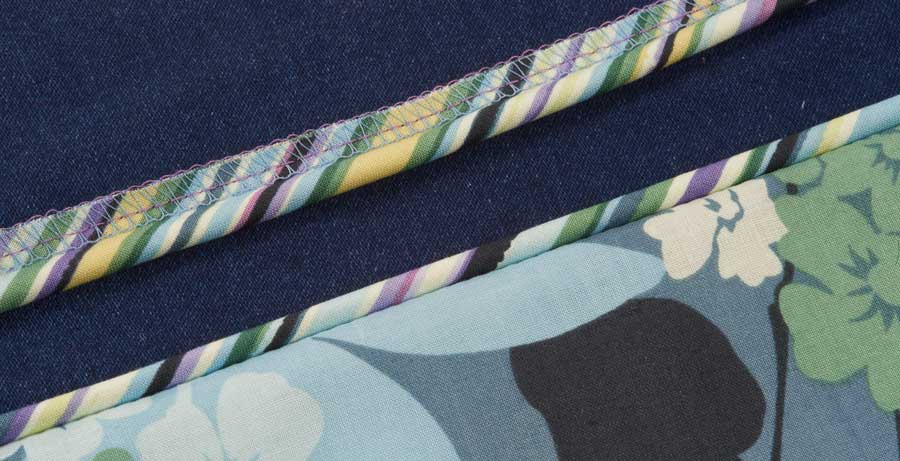
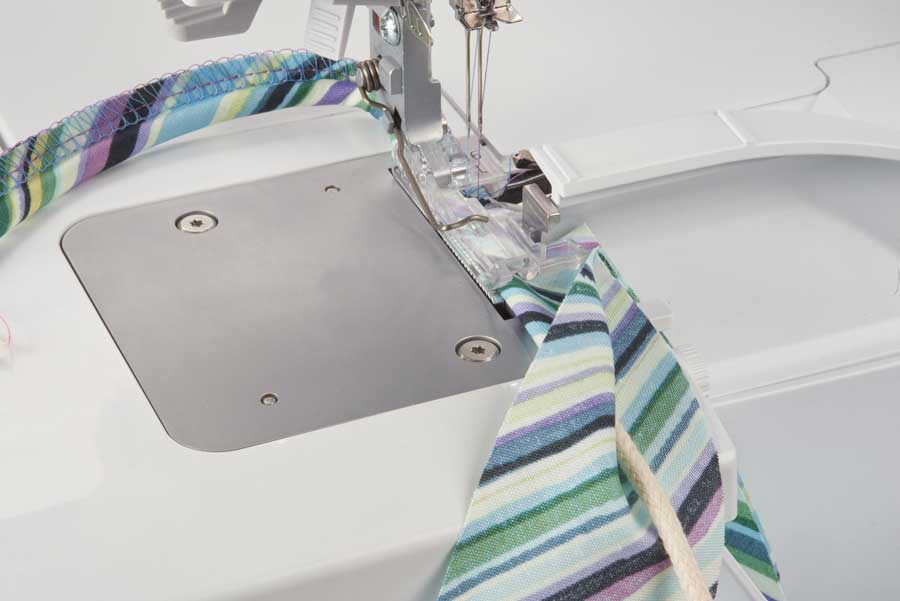
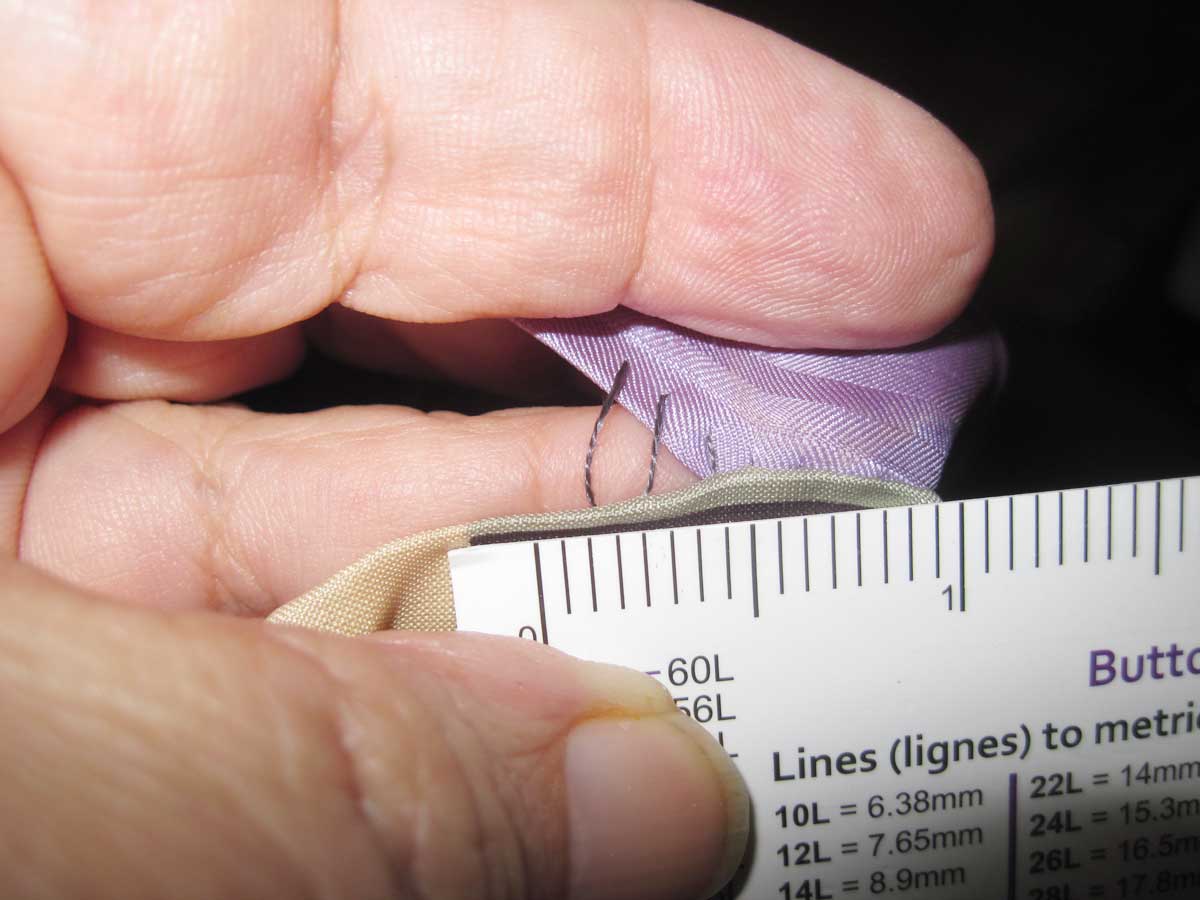
Yet another option is to thread the serger chain ends back through the serger stitch itself. You can use a tapestry needle or loop puller to slide the chain ends back about an inch through the looper stitches before trimming the ends. A needle threader can be helpful for getting the chain into the needle eye and corralling multiple threads together. {photo}

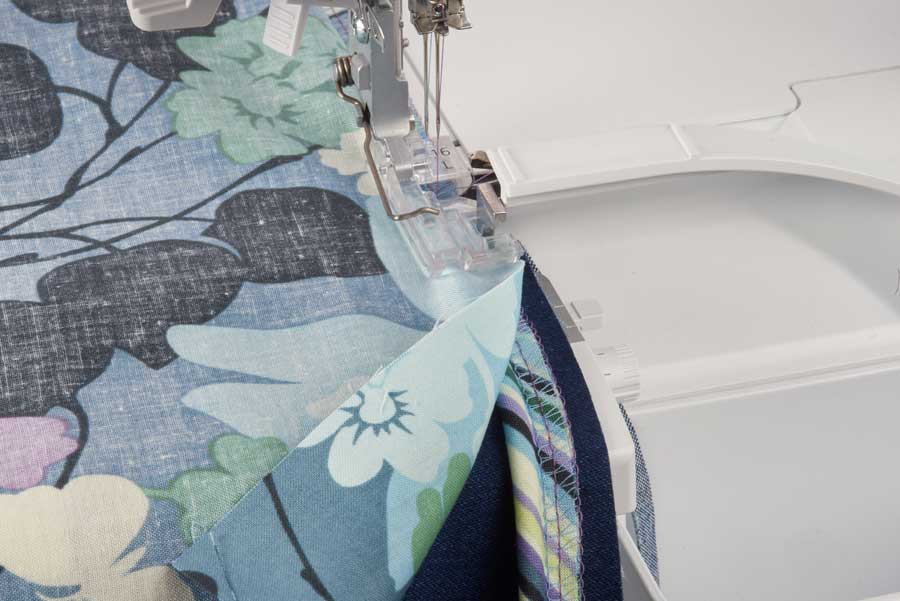
As you begin to sew a line of serger stitches, it’s easy to secure the tail at the same time, by simply lifting the presser foot and bringing it around to the top surface of the fabric. Lay it on the fabric where the looper stitches will encase it as you serge the seam. It’s important that the chain lies between the needle and the blade to avoid cutting it.

Wrapping it up

Choosing the right method for ending it all depends primarily on the location of the area you’re securing. For outside and decorative stitching, choose a method that’s as unobtrusive as possible. Inside, select a method that gives a secure finish without too much bulk for your project.


~Linda Griepentrog
Linda is the owner of G Wiz Creative Services and she does writing, editing and designing for companies in the sewing, crafting and quilting industries. In addition, she escorts fabric shopping tours to Hong Kong. She lives at the Oregon Coast with her husband Keith, and two dogs, Yohnuh and Abby. Contact her at gwizdesigns@aol.com.
Tagged With: serger, sewing, sewing tips

  • « Previous Page
  • 1
  • …
  • 7
  • 8
  • 9
  • 10
  • 11
  • Next Page »

Become a Member

Join the only national organization dedicated to Advancing Sewing as an Art and Life Skill.

Join Now button

Blog Article Categories

  • ASG Conference
  • Chapter Stories
  • Embroidery
  • Fitting
  • Learn to Sew
  • National Sewing Month
  • Products, Books, & Patterns
  • Projects
  • Quilting
  • Sewing
  • Sewing Techniques
  • Sewing Tips
  • Sewing Tours
  • Videos
  • Disclaimer
  • Privacy Policy

American Sewing Guild
National Headquarters
9660 Hillcroft, Suite 230
Houston TX 77096
713-729-3000 | 713-721-9230 Fax
www.ASG.org

ASG wordcloud - education, conference, discounts, videos, special offers, tours and more

Copyright © 1998–2026 · American Sewing Guild · All Rights Reserved